

Literature Review on Maxwell’s Displacement Current for Energy and Sensors
📚 Main Source
Title: On Maxwell’s displacement current for energy and sensors: the origin of nanogenerators
Author: Zhong Lin Wang
Publication Year: 2017
Link: ScienceDirect Article
🌐 Other Sources
📝 Introduction
In the paper, the author starts with explaining the importance of self-powering technology. He says that in the world of IoT, devices like environmental monitors, medical devices, and security tools are a necessary part of life. These devices mostly run on batteries. The gigantic quantity of these devices on the planet makes them an environmental hazard if powered by batteries.
Batteries also have limited lifespan and high maintenance costs. Most of IoT would be impossible without making the devices self-powered by harvesting energy from the working environment. This takes us to the motive to develop nanogenerators.
The author explains Maxwell’s displacement current for understanding nanogenerators by saying:
“The displacement current is not an electric current of moving free charges, but a time-varying electric field (vacuum or media), plus a contribution from the slight motion of charges bound in atoms, dielectric polarisation in materials.”
📖 Description
The Maxwell’s displacement current can be given as:
(Equation not shown in original text)
The first term gives us the EM waves, but the second term is explained by the author further. They show the contribution of the displacement current to energy and sensors in the near future and the relation of the second term to the output from nanogenerators.
A piezoelectric material is made by placing two electrodes on bottom and top surfaces. When vertical mechanical deformation happens, an electrostatic potential is created by polarization, which is balanced by movement of charges through an external load. This converts mechanical energy to electrical energy.
The displacement current from piezoelectric material is given by:
(Equation not shown in original text)
Where S is a mechanical third-order strain matrix and P is the polarization. This equation means the change in rate of applied strain is proportional to output current density.
The author starts with a basic model of TENG (triboelectric nanogenerator) by taking four layers in contact separation mode. Once the two dielectrics are driven to physical contact, electrostatic charges are transferred to the surfaces of the two due to the contact electrification effect. The surface is partially charged and the charges are non-mobile static charges.
The field created by triboelectric charges drives negative charges to flow from the external load, and free electrons accumulate in electrodes. This is a function of gap distance — a process of converting mechanical energy to electrical energy.
The displacement current for this four-set probe is:
(Equation not shown in original text)
This equation means that the displacement current density is proportional to the charge density on the dielectric surface and the speed at which the two dielectrics are being separated or contacted. This defines the output characteristics of the TENG.
✅ Conclusion
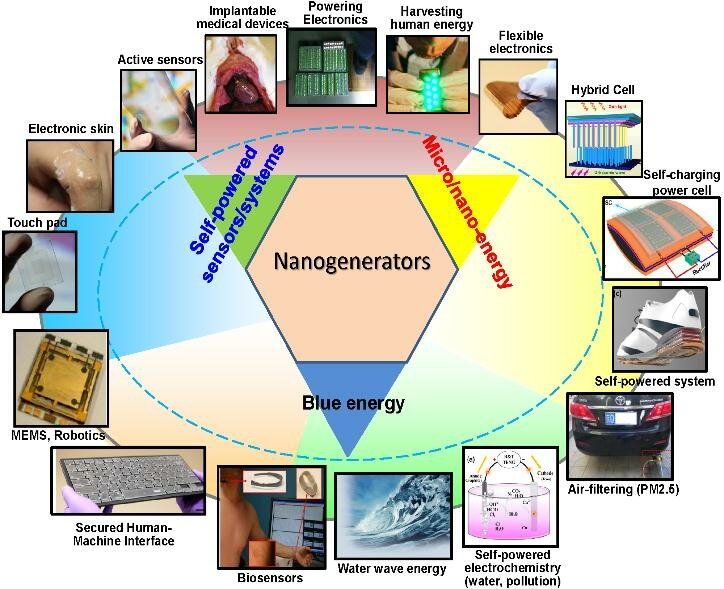
There are three distinct applications of TENG:
- Sustainable nano power source
- Active sensors for human–machine interaction, medicine, security
- Basic network units
TENGs can be used to harvest mechanical energies that are wasted daily. They are effective for:
- Human motion
- Walking
- Vibration
- Mechanical triggering
- Rotating tires
- Wind
- Flowing water
A TENG can also be used as a self-powered sensor for detecting both static and dynamic mechanical processes using voltage and current output signals. Potential applications include mechanical sensors, touchpads, and smart skin technologies.