

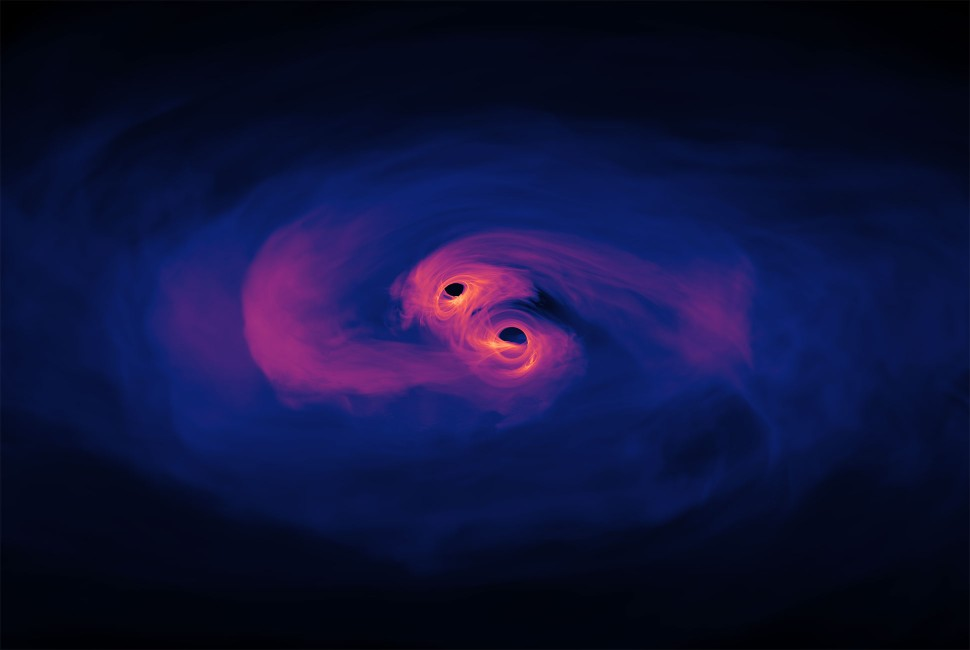
Literature Review: Birth, Life, and Death of Black Hole Binaries Around Supermassive Black Holes
📚 Main Source
Title: Birth, Life, and Death of Black Hole Binaries Around Supermassive Black Holes: Dynamical Evolution of Gravitational Wave Sources
Author: Manuel Arca Sedda
arXiv ID: arXiv:2002.04037v1
Publication Year: 2020
🌐 Related Resources
📝 Introduction
Black holes have long intrigued astrophysicists—not just for their mysterious physics, but because of their profound role in cosmic evolution. Nearly every galactic center harbors a supermassive black hole (SMBH), influencing the dynamics of their host galaxies.
This study explores the formation and evolution of stellar-mass black hole binaries (BHBs) in the gravitational influence of SMBHs. Using N-body simulations, the author analyzes their interactions and long-term evolution.
Key insights from the study:
- Galactic nuclei are prime environments for black hole binary formation.
- ~40% of BHBs lie in the mass range 50–140 M⊙.
The Milky Way itself contains an SMBH near Sagittarius A* at the Galactic Core. Most SMBHs likely formed early in cosmic history due to high mass densities and frequent black hole mergers.
📖 Description
The evolution of a BHB near an SMBH is modeled as a three-body system, with distinct phases (0 to 3) that describe stages of binary life:
Phase 0:
- 0a – In-Situ Formation: Binary forms within the system.
- 0b – Dry Merger: Binary is delivered from another system into the SMBH’s influence.
Phase 1:
- Dynamical Friction: Drives the black hole binary inward.
- Influenced by mass segregation and hardening (increasing binding energy).
Phase 2:
- The binary orbits the SMBH in a stable configuration.
- Governed by the tidal field of the SMBH.
- Kozai–Lidov mechanism becomes dominant, causing oscillations in eccentricity and inclination.
Simulation Details
Simulations replicate conditions similar to our Galactic nucleus:
- SMBH mass: 10⁸ M⊙
- Globular cluster: 10⁶ M⊙
- Intermediate-mass black holes (IMBHs): 10⁴ M⊙
- Binary separation: Limited to 100× Schwarzschild radii
The study evaluates binary trajectories under different interaction scenarios:
- No interaction: Direct orbital evolution
- Multiple encounters: A sample of 100 simulated three-body interactions
- Outcomes: Ejection, exchange, disruption, or resonance
- Categorization depends on number and type of encounters
✅ Conclusion
The simulation covers two main formation channels:
- In-situ formation
- Delivery via external dynamics
Key findings:
- Dense nuclear clusters (NCs) increase BHB–SMBH interaction rates.
- Mass segregation and scattering lead to black hole mergers > 50 M⊙
- Resulting BHB mergers match the mass distribution observed in gravitational wave detections
This study underscores the role of dense galactic environments in the evolution and detection of black hole binaries—key sources for gravitational wave astronomy.